
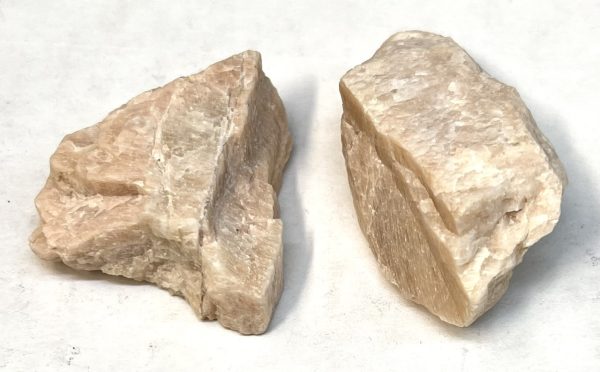
Feldspar is the most commonly used fluxing material in ceramics. It serves as a fundamental component in ceramic production, used in large quantities as a raw material for bodies, glazes, colorants, and fluxes, and is one of the three major raw materials for ceramics.
Its chemical composition is anhydrous alkaline earth metal aluminosilicates containing alkali metals, potassium, sodium, calcium, and a small amount of barium.
What is referred to as potassium feldspar in production is actually potassium-sodium feldspar, which is predominantly potassium.
What is referred to as sodium feldspar is actually potassium-sodium feldspar, which is predominantly sodium.
Feldspar with a higher potassium content is generally pink or flesh-colored, while sodium feldspar is generally white or grayish-white.
To facilitate sintering of the body while preventing deformation, it is generally desirable for feldspar to have a low melting temperature, a wide melting range, high molten liquid viscosity, and good ability to dissolve other substances.
Melting range: Potassium feldspar 1130~1450℃; Sodium feldspar 1120~1250℃. Within this temperature range, it gradually softens and melts, becoming a glassy substance.
Potassium feldspar melts into a highly viscous melt, and this viscosity gradually decreases with increasing temperature. This is beneficial for firing control and preventing deformation in ceramic production.
Sodium feldspar melts at a lower temperature than potassium feldspar, resulting in a lower viscosity liquid phase with a narrower melting range. Its viscosity decreases more rapidly with increasing temperature, making its use in raw materials prone to causing product deformation. However, sodium feldspar exhibits the fastest and greatest solubility in quartz, clay, and mullite at high temperatures, making it highly suitable for use in glazes.
For daily-use ceramics, potassium-sodium feldspar with a higher potassium content is generally selected. The K₂O and Na₂O content is typically no less than 11%, with a K₂O:Na₂O mass ratio greater than 3. The suitable feldspar for ceramic production requires a eutectic temperature below 1230℃ and a melting range of no less than 30-50℃.
The main functions of feldspar in ceramic production can be summarized as follows:
① Feldspar melts at high temperatures, forming a viscous glassy melt, which lowers the melting temperature of the ceramic body components, facilitating porcelain formation and reducing firing temperature.
② The molten feldspar dissolves some kaolin and quartz particles, promoting the formation and growth of mullite crystals, thus imparting mechanical strength and chemical stability to the body.
③ The feldspar melt fills the spaces between crystalline particles, making the body denser and reducing porosity. After cooling, the feldspar melt forms the glassy matrix of the porcelain, increasing transparency and contributing to improved mechanical strength.
④ In glazes, feldspar is a major flux and a key component in forming the glassy phase.
⑤ As a lean raw material, feldspar can also shorten the drying time of the body during the greening process, reducing drying shrinkage and deformation.