
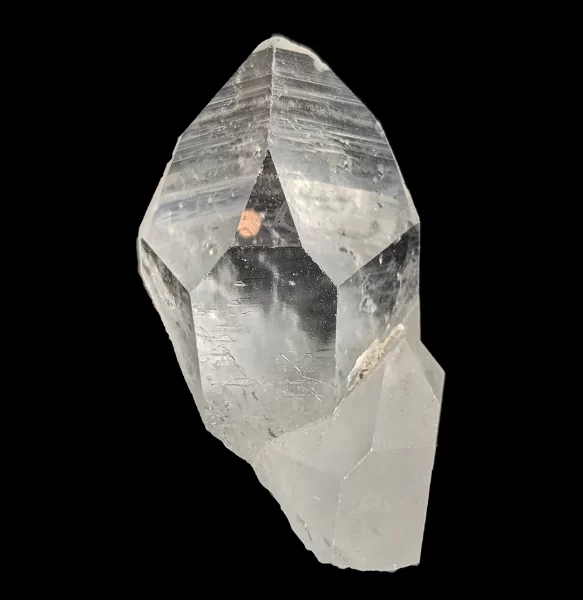
Based on their geological origins and ore characteristics, industrial quartz deposits can be classified into seven distinct types. Ranging from crystal-clear natural quartz crystals to the hard-textured quartz found in granite, each type possesses unique value and specific application scenarios.
Natural Quartz Crystals
Currently, the primary applications for natural quartz crystals are concentrated in two major fields: First, the crafts and decorative arts sector, where their unique crystal habits and coloration make them ideal for crafting ornamental pieces, jewelry, and similar items; second, the specialized optics sector*, where high-purity natural crystals are utilized to manufacture piezoelectric crystals, birefringent filters, optical rotators, and other components that play critical roles in telecommunications, laser technology, and military applications.
Quartz Sandstone
Due to its abundant reserves and low processing costs, quartz sandstone is one of the most widely utilized types of quartz. Its core applications are concentrated within traditional industrial sectors: First, *glass manufacturing*, where it serves as the primary raw material for producing flat glass, glassware, and photovoltaic glass; second, the *ceramics industry*, where it is used in the production of ceramic glazes and bodies to enhance the hardness and abrasion resistance of ceramic products; and third, the *construction sector*, where it is processed into quartz sand for use in concrete, mortar, road paving, and various other building applications.
Quartzite
The core advantage of vein quartz lies in its exceptional purity, making it primarily suited for high-end industrial applications: First, the *processing of high-purity quartz sand*, which—following purification—is utilized in the semiconductor, photovoltaic, and optical industries; second, the *production of microcrystalline silica powder*, which is incorporated into electronic packaging materials, coatings, and rubber products to enhance their electrical insulation and abrasion resistance; and third, the *manufacturing of quartz slabs and high-end glass*, though it also finds application in the smelting of industrial silicon. Due to its high purity and stable quality, it has gradually replaced natural quartz, becoming one of the primary raw materials for the processing of high-purity quartz.
Powdered Quartz
Distinguished by its fine particle size and high whiteness, powdered quartz is primarily utilized in precision processing sectors: First, in the ceramics industry, where it serves as a raw material for ceramic bodies and glazes, enhancing the fineness and luster of the finished products; second, in the coatings and plastics industries, where it functions as a filler to improve product resistance to corrosion and abrasion, as well as its surface gloss; third, in the fields of insulation and refractory materials, where it is used to manufacture high-temperature insulation products, refractory coatings, and similar items.
Natural Quartz Sand
The core advantage of natural quartz sand lies in its natural formation process, which results in low processing costs and enables an exceptionally wide range of applications: First, in the foundry industry; second, in emerging sectors—such as 3D printing sand, colored quartz sand, and petroleum proppants (frac sand)—where it meets the specific demands of industries like new energy and petroleum extraction; and third, in the construction and water treatment sectors, where it is utilized for road paving, filtration media, and similar purposes.
Granite Quartz
It is formed primarily during the late stages of magmatic evolution, specifically through the slow crystallization of volatile-rich granitic magma. Geologically, it is classified as a pegmatite-type deposit within the category of endogenic mineral deposits. The formation process of granite quartz imposes extremely stringent requirements regarding temperature, pressure, and magmatic composition; consequently, such deposits are inherently rare.